


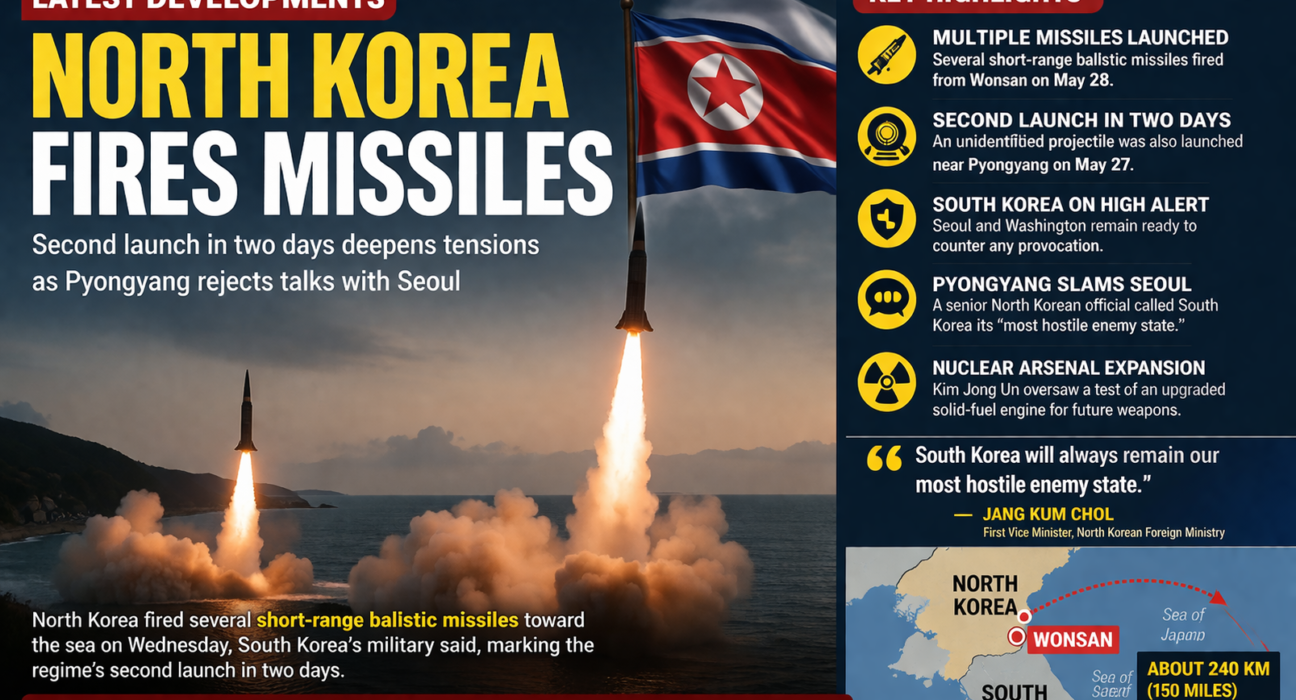
North Korea missile launch activity intensified on Wednesday as the country fired several short-range ballistic missiles toward its eastern waters, marking the second launch within two days, according to South Korea’s military.
South Korea’s Joint Chiefs of Staff said the missiles were launched from the eastern coastal city of Wonsan. Each missile traveled about 240 kilometres before landing in the sea. Officials confirmed that South Korea remains fully prepared to respond under its alliance with the United States.
On Tuesday, South Korean forces also detected an unidentified projectile launched near Pyongyang. Military officials from South Korea and the United States are still examining the details of that launch.
Local media reports indicated that Tuesday’s launch likely failed. The projectile reportedly disappeared from radar shortly after launch due to an abnormal development.
The back-to-back tests come at a time of rising tension between North and South Korea. Pyongyang has made it clear that it has no interest in improving relations with Seoul.
Senior North Korean official Jang Kum Chol strongly criticized South Korea’s government, calling it the country’s “most hostile enemy.” He dismissed recent comments by Kim Yo Jong, sister of leader Kim Jong Un, as being misunderstood by South Korea.
Earlier this week, Kim Yo Jong acknowledged South Korean President Lee Jae Myung’s remarks regarding alleged drone activity but warned of retaliation if such incidents continue. South Korean officials had viewed her comments as a positive signal, but North Korea later clarified that it was a warning.
North Korea has refused to resume talks with South Korea and the United States since diplomatic efforts collapsed in 2019 during discussions between Kim Jong Un and then U.S. President Donald Trump.
In recent developments, Kim Jong Un supervised a test of an upgraded solid-fuel engine. Experts believe this advancement could support the development of stronger intercontinental ballistic missiles capable of carrying multiple nuclear warheads.
Solid-fuel missiles are more difficult to detect and faster to deploy compared to liquid-fuel systems, making them a significant concern for regional security.
South Korea’s intelligence agency suggested that the engine test is part of North Korea’s effort to strengthen its long-range missile capabilities. However, experts say the country still faces technical challenges in developing reliable multi-warhead systems.